efficiency · cost-aware · collective intelligence
LLM Routing
I study how language-model systems can choose the right model or group of models for each task, balancing performance, efficiency, and cost.
Selected work
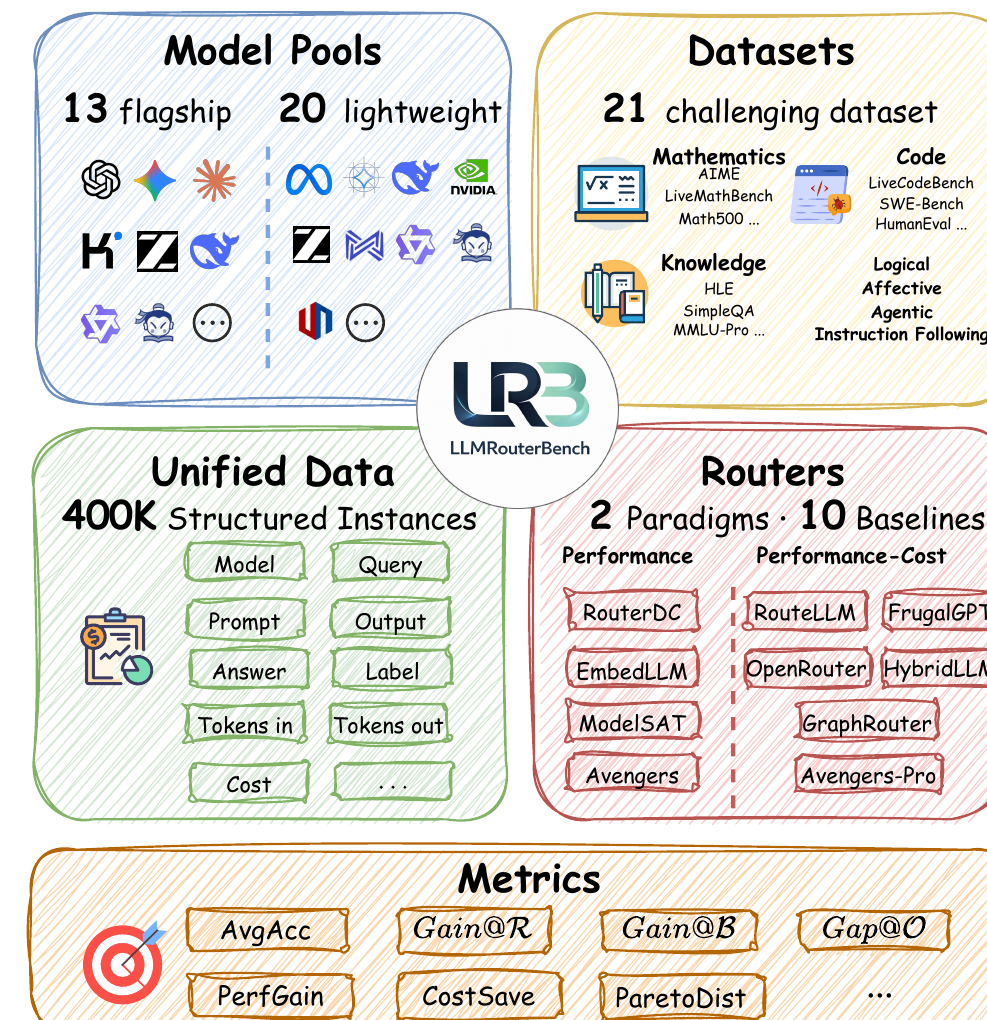
LLMRouterBench: A Massive Benchmark and Unified Framework for LLM Routing
We build a 400K-instance routing benchmark over 21 datasets and 33 models, showing strong model complementarity but also that many routers still fail to beat simple baselines reliably.
Read ↗ACL Findings 2026
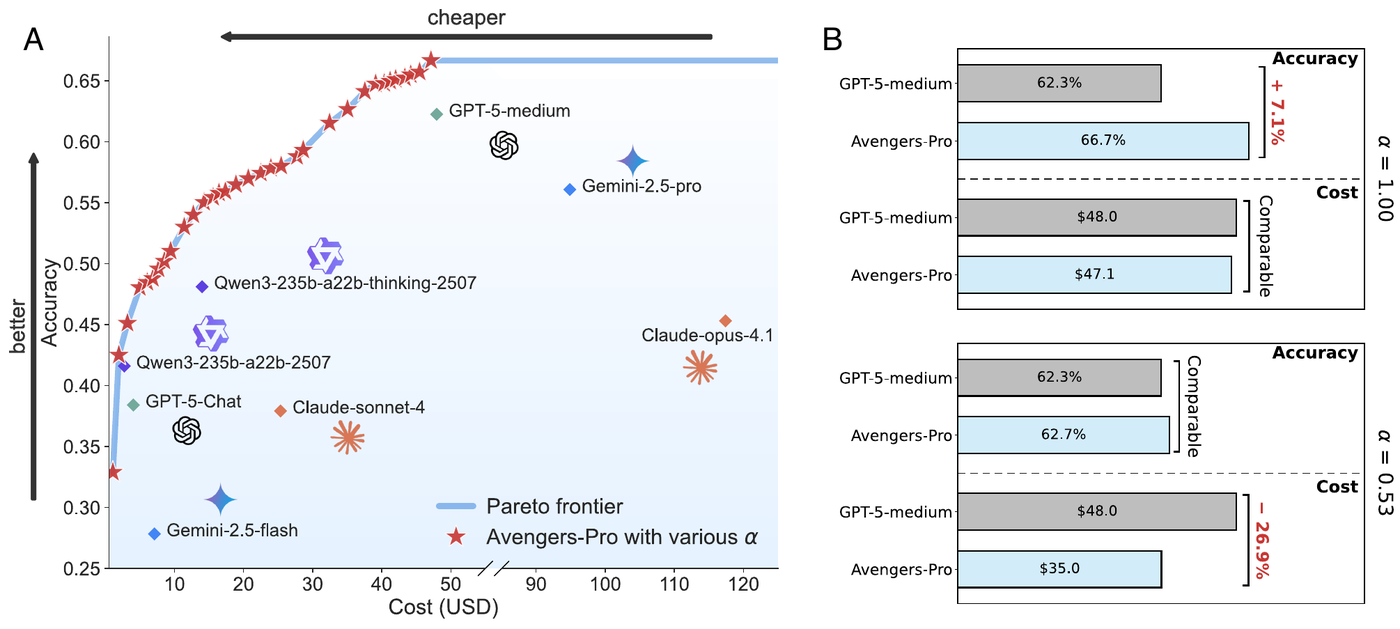
Beyond GPT-5: Making LLMs Cheaper and Better via Performance-Efficiency Optimized Routing
We introduce Avengers-Pro, a performance-efficiency router that can surpass GPT-5-medium by 7% average accuracy or match its accuracy at 27% lower cost.
Read ↗DAI 2025 Best Paper Award
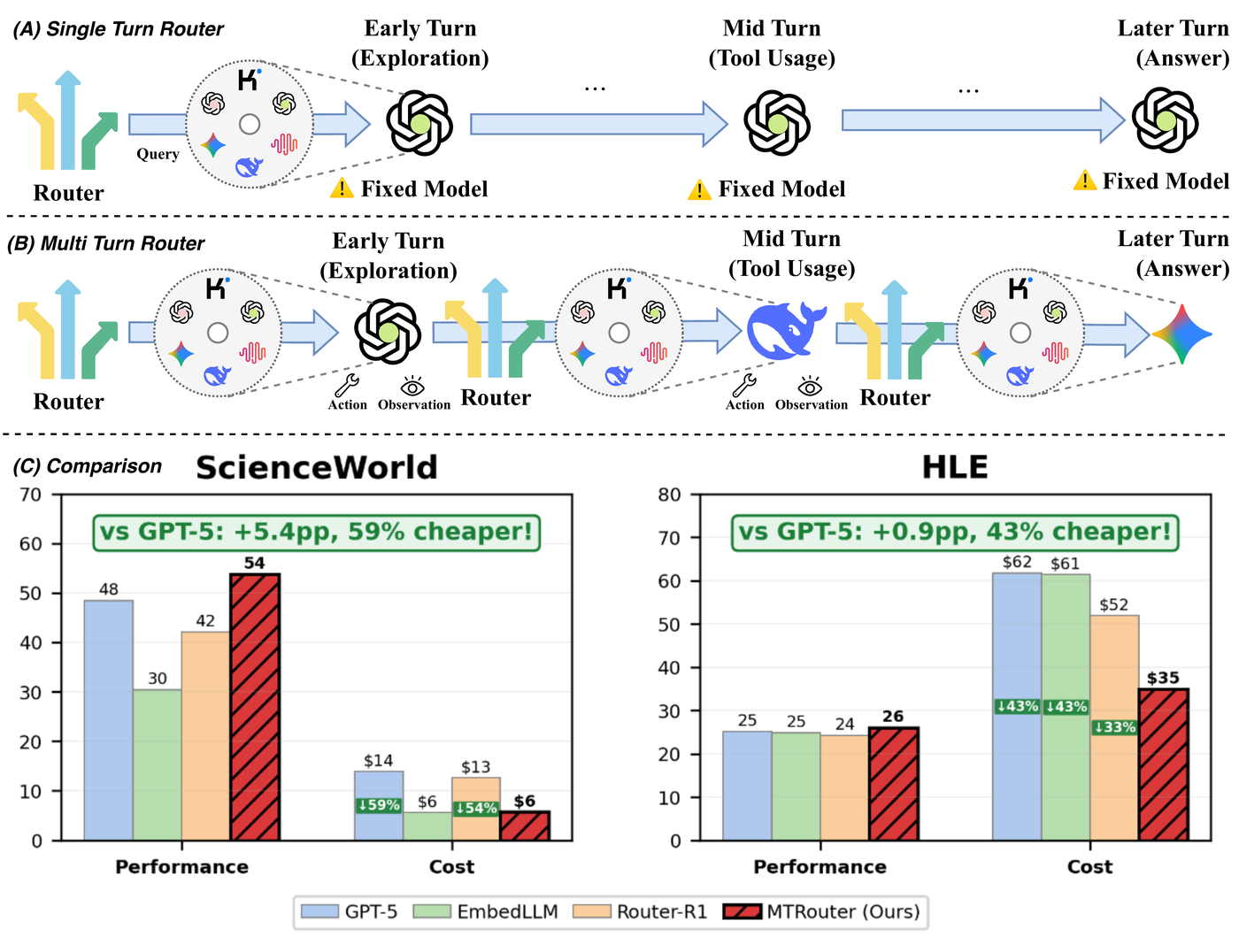
MTRouter: Cost-Aware Multi-Turn LLM Routing with History-Model Joint Embeddings
We route each turn using history-model embeddings, improving ScienceWorld performance while cutting GPT-5 cost by 58.7% and reducing HLE cost by 43.4%.
Read ↗ACL 2026
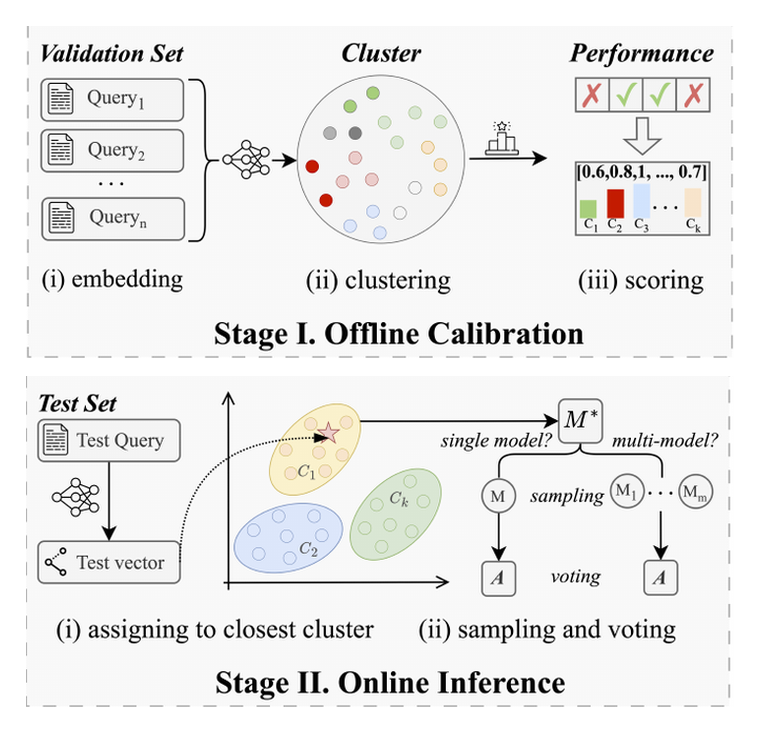
The Avengers: A Routing Recipe for Collective Intelligence in Language Models
We combine embedding, clustering, scoring, and voting so ten open-source 7B models collectively surpass GPT-4o, GPT-4.1, and GPT-4.5 on average across 15 datasets.
Read ↗AAAI 2026
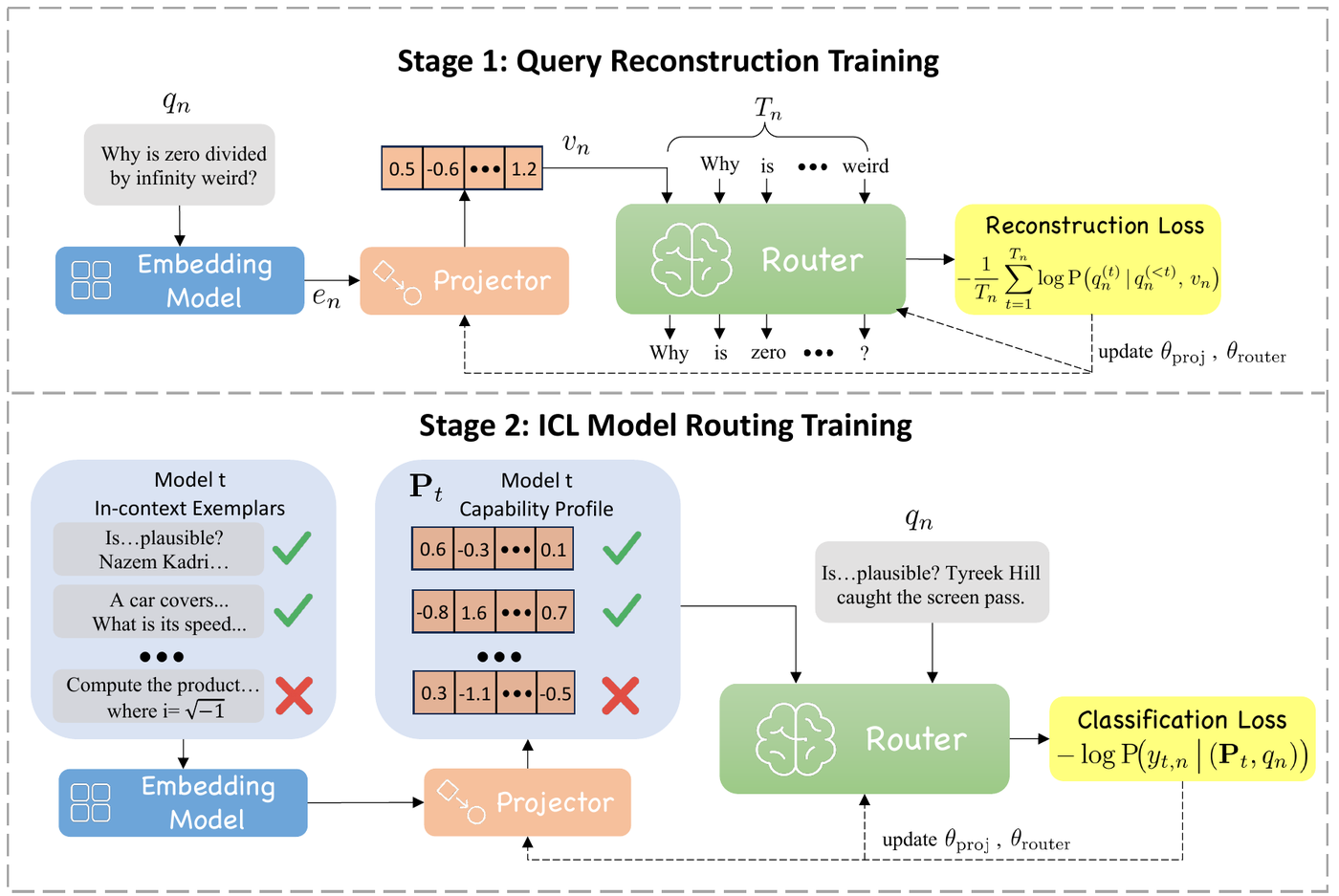
ICL-Router: In-Context Learned Model Representations for LLM Routing
We represent model capabilities with in-context vectors, reaching state-of-the-art routing on in-distribution and out-of-distribution tasks while adding new models without retraining.
Read ↗AAAI 2026
social norms · cooperation · coordination
Agent Societies
I explore how agent communities coordinate, cooperate, and form social norms, particularly when they may have conflicts of interest.
Selected work
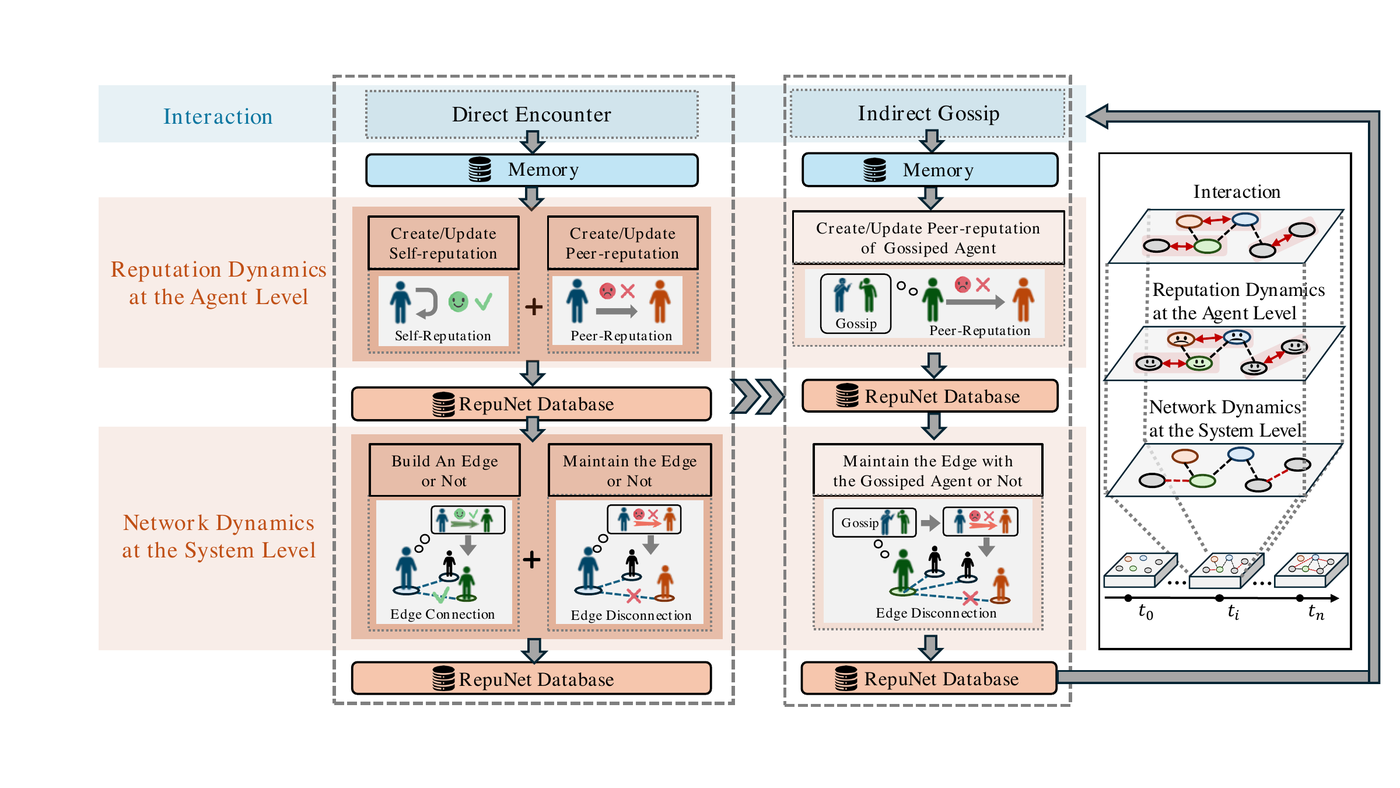
Beyond the Tragedy of the Commons: Building A Reputation System for Generative Multi-agent Systems
We propose RepuNet, a dual-level reputation framework that prevents cooperation collapse and produces cooperative clusters, social isolation of exploiters, and positive gossip dynamics.
Read ↗AAMAS 2026 Best Student Paper Nominee
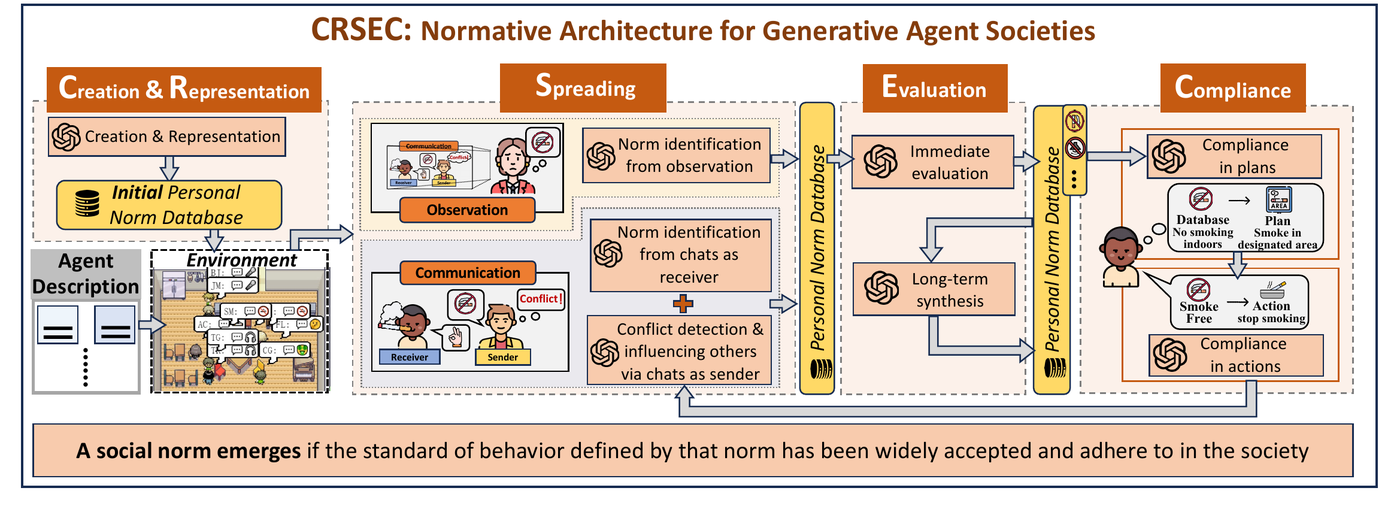
Emergence of Social Norms in Generative Agent Societies: Principles and Architecture
We design CRSEC to create, spread, evaluate, and enforce norms in generative agent societies, reducing social conflicts in Smallville-style simulations with supporting human evaluation.
Read ↗IJCAI 2024
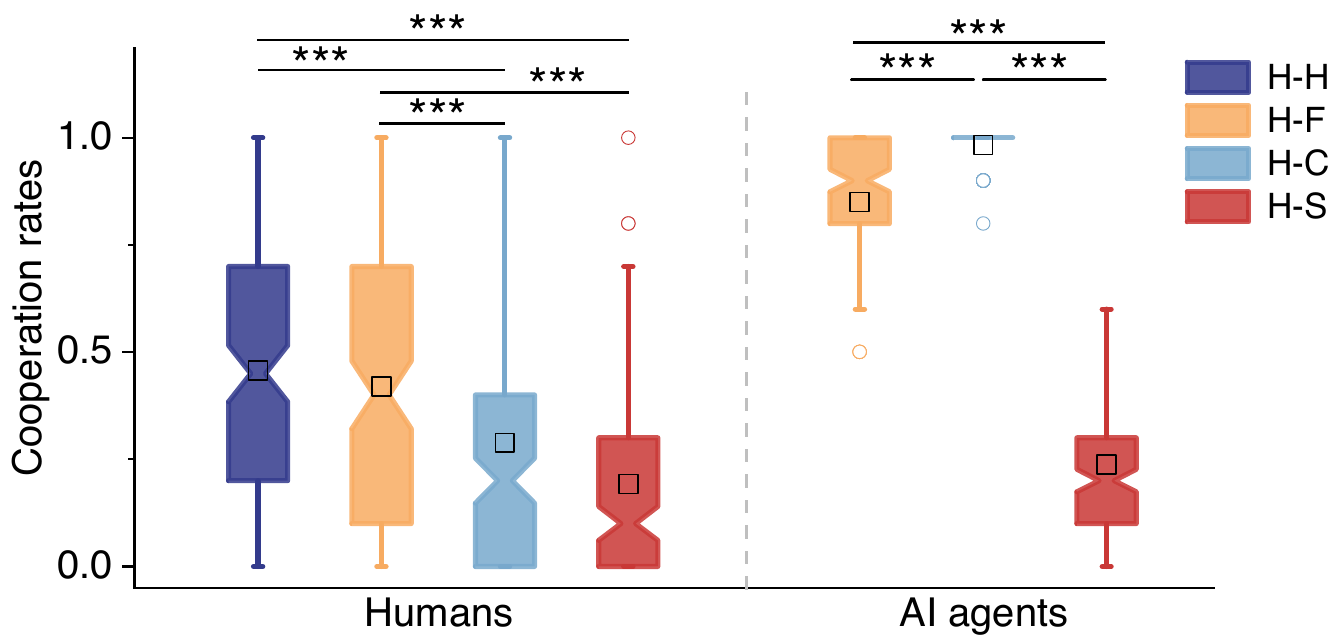
LLM agents overcome the machine penalty when acting fairly but not when acting selfishly or altruistically
In a pre-registered experiment with 1,152 participants, we show that fair LLM agents overcome the machine penalty in social dilemmas, while selfish or altruistic personas do not.
Read ↗National Science Review 2026
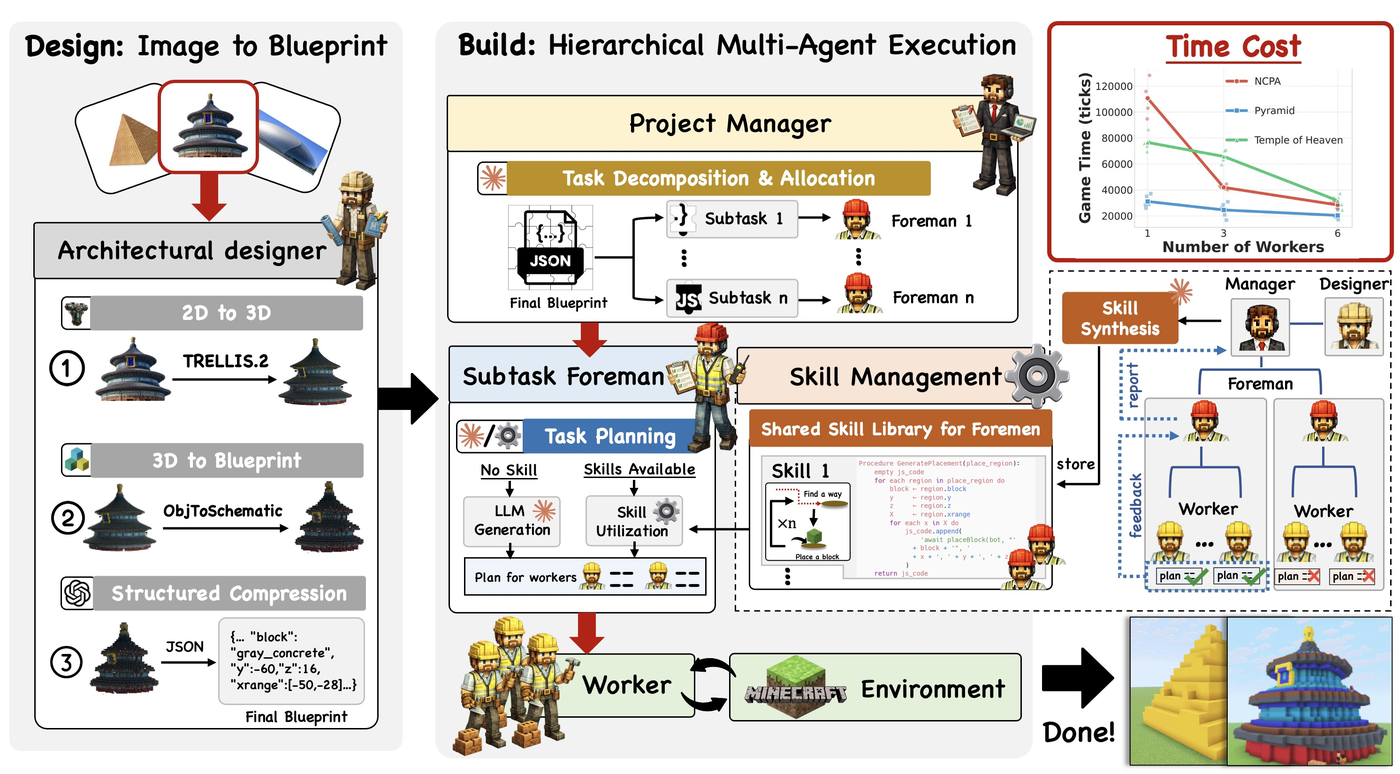
CraftUtopia: A LLM-based Multi-Agent System for Collaborative Construction in Minecraft
We build a hierarchical multi-agent Minecraft system that constructs 3D buildings from a single 2D image, achieving 100% success across representative builds and faster construction with more workers.
AAMAS 2026 Best System Demo Award
self-improving · agent skills · autonomy · long-horizon
Agent Harness
I work on the infrastructure around agents: harnesses that organize skills, support autonomous long-horizon behavior, benchmark tool use, and eventually improve themselves.
Selected work
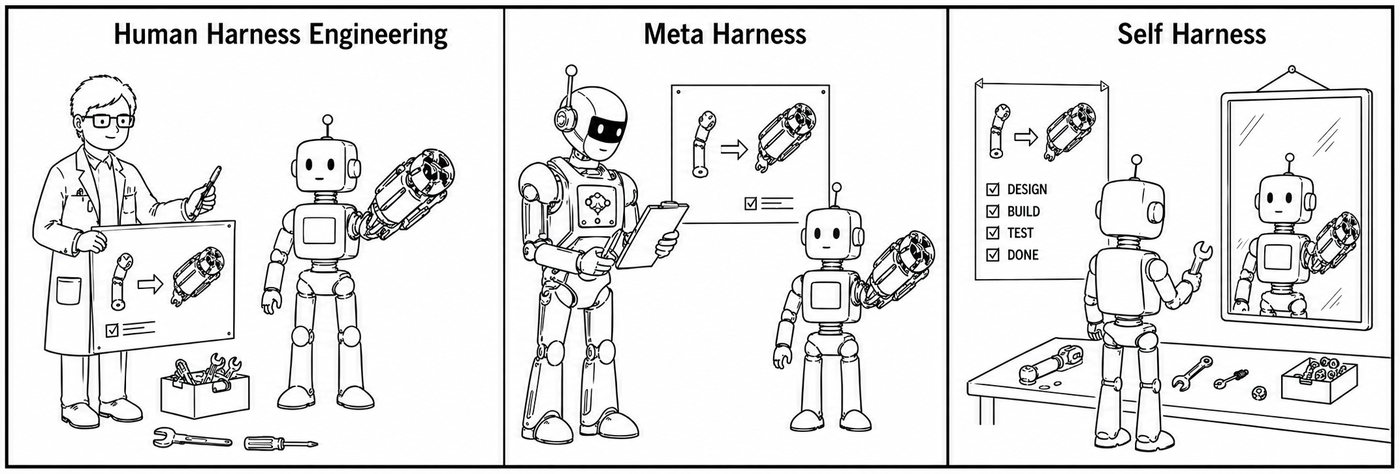
Self-Harness: Harnesses That Improve Themselves
We let agents mine failures, propose harness edits, and validate them with regression tests, improving held-in and held-out pass rates across all nine model-benchmark combinations.
Read ↗arXiv
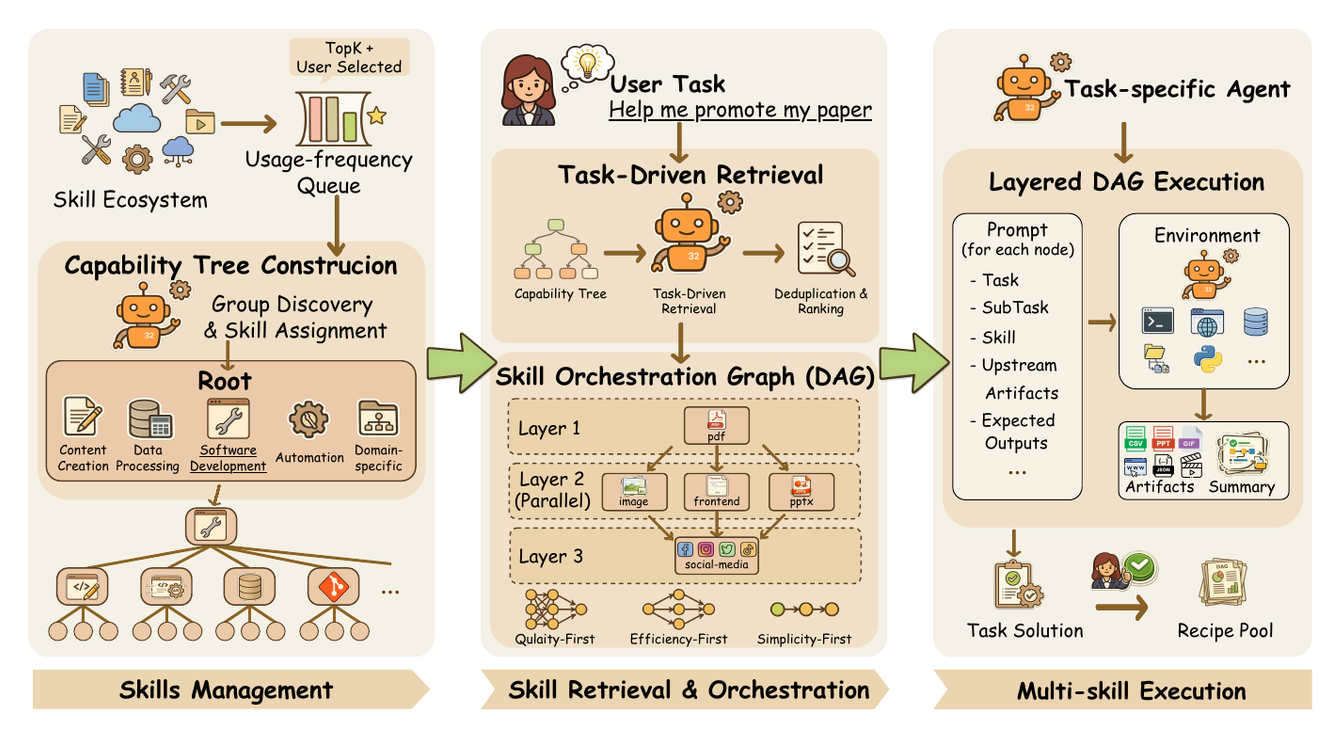
Organizing, orchestrating, and benchmarking agent skills at ecosystem scale
We introduce AgentSkillOS, organizing skills as a capability tree and orchestrating them as DAG pipelines, with tree retrieval and DAG composition outperforming flat skill invocation at ecosystem scale.
Read ↗Submitted to TMLR